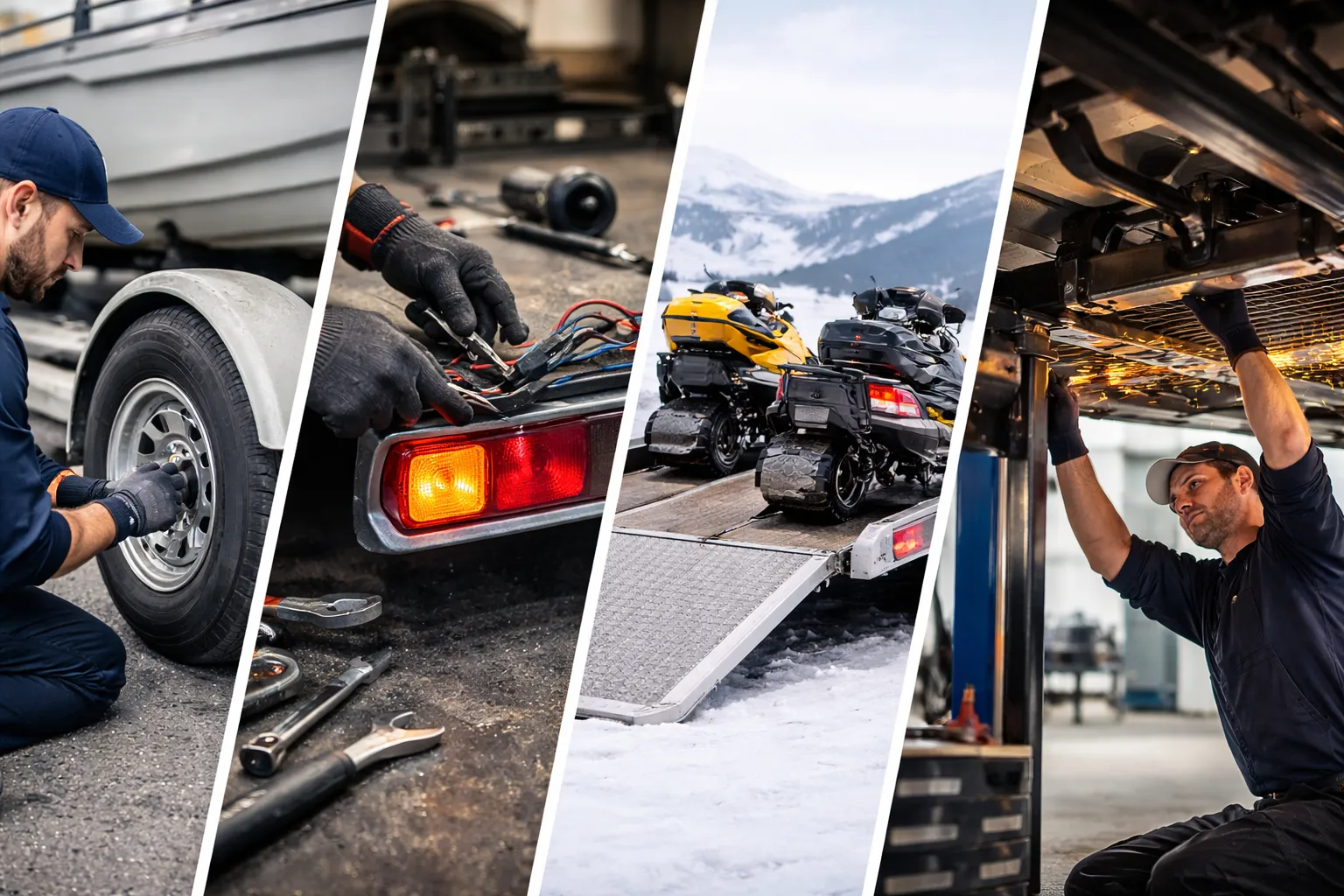
Trailer repair services at Combustion Motorworks LLC in Center Barnstead NH

Center Barnstead, New Hampshire

Trailer Repair in Barnstead, NH

Trailer lights not working? Brakes feeling soft? Deck boards rotting through? Combustion Motorworks LLC provides dependable trailer repair in Center Barnstead, NH for utility, landscape, snowmobile, and recreational trailers. We diagnose the problem, explain what we find, and fix it right — so your trailer is safe and road-ready before your next trip. Serving the Lakes Region and central New Hampshire.

Trailer Services We Provide

We handle the full range of trailer repairs — from a simple wiring fix to brake system service, suspension work, deck replacement, and structural welding. Whatever your trailer needs, we'll assess it honestly and give you a clear estimate before any work starts.

  • Trailer wiring diagnosis and repair — running lights, brake lights, turn signals
  • Connector and harness repair — 4-pin, 7-way, and custom configurations
  • Bad ground diagnosis and repair — the most common cause of intermittent trailer lighting faults
  • Surge brake service — actuator, brake fluid, master cylinder, and brake hardware
  • Electric trailer brake service — magnets, wiring, and controller diagnosis
  • Suspension repairs — leaf springs, hangers, shackles, equalizers, and related hardware
  • Deck board replacement — utility and landscape trailers
  • Structural repairs and welding — broken brackets, cracked mounts, frame damage
  • General trailer safety checks — coupler, safety chains, tires, bearings, and hardware

Trailer Wiring and Lighting — The Most Common Issue We See

Trailer lighting problems are the number one reason people bring trailers to us, and they're also the most frequently ignored — right up until a traffic stop or a close call on the highway. A trailer with non-functional brake lights or turn signals is a genuine safety hazard and a legal liability.

The most common causes of trailer lighting failure are surprisingly straightforward once you know what to look for. Bad grounds account for the majority of intermittent or partial lighting failures — a corroded or loose ground connection at a light fixture or at the connector causes erratic behavior that can be hard to trace without systematic testing. Corroded connectors — especially 4-pin and 7-way plugs that have been exposed to road salt and moisture over multiple winters — are the second most common culprit. Damaged wiring from road debris, rubbing against the frame, or rodent damage accounts for most of the rest.

We trace trailer wiring faults to their actual source. Rather than replacing an entire harness when a single corroded splice is the problem, we test systematically and fix what's actually broken. If the harness is too far gone to repair cost-effectively, we'll tell you that and give you options.

Surge Brakes and Electric Trailer Brakes

Trailer brakes are one of those systems that gets ignored until something goes obviously wrong — but by then, degraded braking has already been creating unsafe towing conditions for a while. If your trailer has brakes, they're worth maintaining properly.

Surge brakes use a hydraulic actuator in the trailer coupler that activates the brakes when the tow vehicle slows and the trailer pushes forward against the hitch. Common problems include a leaking master cylinder, a stuck or corroded actuator, contaminated brake fluid, and worn brake hardware — all of which result in reduced or uneven braking. Surge brake systems also require periodic fluid service, which is frequently overlooked.

Electric brakes are controlled by a brake controller in the tow vehicle and engage electromagnetically. Issues we commonly see include worn or failed brake magnets that no longer engage properly, wiring faults between the controller and the trailer, corroded connections at the brake assemblies, and controller settings that are out of adjustment. A trailer that's pushing your tow vehicle forward under braking is a sign the electric brake system needs attention.

We service both systems and can diagnose which component is causing the problem before recommending any parts replacement.

How New Hampshire Winter Affects Your Trailer

Trailers take a harder beating from NH winters than most owners realize, and the damage tends to be cumulative — each season adding a little more corrosion, a little more wear, until something fails at the worst possible moment.

Road salt is the primary culprit. Salt accelerates corrosion on everything — wiring connectors, brake hardware, suspension components, coupler mechanisms, and structural fasteners. A 7-way connector that looked fine in October can be heavily corroded by April after a winter of road salt exposure. Leaf spring hardware and brake components are particularly vulnerable.

Freeze-thaw cycles are hard on wooden decking. Water gets into cracks in the wood, freezes, expands, and accelerates the deterioration process. What starts as minor checking in the surface boards can progress to soft, rotten decking that's genuinely unsafe for supporting loads.

Bearing wear increases when trailers sit unused for extended periods, especially in wet conditions. Trailer wheel bearings are often neglected until they fail — a failed bearing at highway speed can cause a wheel to separate from the trailer, which is a serious safety event.

We recommend a spring trailer check after the salt season ends — it's the best time to catch corrosion and wear before it becomes a failure. A quick inspection of lights, brakes, suspension, decking condition, and coupler hardware takes very little time and can prevent a much more expensive repair down the road.

Utility, Landscape, Snowmobile & Recreational Trailers

Utility Trailers

The workhorse of the trailer world — and often the most neglected. We handle lighting repairs, wiring faults, deck board replacement, suspension wear, and safety hardware to keep utility trailers reliable for daily use. A utility trailer with rotten decking or non-functional lights isn't safe or legal on NH roads.

Landscape & Equipment Trailers

Heavier loads and more frequent use accelerate wear on brakes, suspension, and structural components. We service surge and electric brake systems, address suspension wear, repair wiring faults, and handle structural repairs and welding for landscape and equipment trailers that take a beating in daily professional use.

Snowmobile & Recreation Trailers

Don't find out your trailer lights don't work on the way to the trails. We address lighting and wiring issues, brake service, and general roadworthiness for snowmobile and recreational trailers before the season starts. Spring is also a good time to address any salt corrosion from winter towing before it gets worse.

Frequently Asked Questions

Do you fix trailer wiring and lights?

Yes. We diagnose and repair wiring faults including lights that don't work or work intermittently. Bad grounds, corroded connectors, damaged harnesses, and failed fixtures are the most common causes. We trace the fault to its actual source rather than replacing parts at random.

What causes trailer lights to stop working?

The most common causes are a bad ground connection, corroded connectors at the tow vehicle plug or at the fixtures, a broken wire in the harness, or a failed bulb or socket. Road salt and moisture accelerate corrosion on trailers significantly — especially on ground connections and multi-pin connectors.

Do you service surge brakes and electric trailer brakes?

Yes — both systems. Surge brake issues we commonly address include weak braking, fluid leaks, sticking actuators, and worn brake hardware. For electric brakes, we diagnose wiring faults, failed brake magnets, and controller issues that result in weak or non-functional braking.

How do I know if my trailer brakes need service?

Signs include longer stopping distances when towing, the trailer pushing the tow vehicle during braking, a brake controller fault light on your dash, uneven braking causing trailer sway, or surge brakes that feel spongy or fail to engage. If your trailer has brakes and you can't remember the last time they were serviced, it's worth having them checked.

Can you replace trailer decking?

Yes. We replace rotted, cracked, or broken deck boards on utility and landscape trailers. Deteriorated decking is a safety hazard — a load breaking through rotten boards is a serious problem. We'll assess the condition and replace what needs to go.

Do you do structural repairs and welding?

Yes. Broken brackets, cracked mounts, frame damage, and other structural concerns. Bring it in and we'll evaluate what's needed and let you know what's involved before any work starts.

Does NH winter affect trailers?

Significantly. Road salt corrodes wiring, connectors, brake hardware, and suspension components. Freeze-thaw cycles accelerate deck rot and stress fasteners. Spring is a good time to have your trailer looked over — catching corrosion early is far cheaper than a failed brake system or a full wiring harness replacement.
Serving the Lakes Region

Combustion Motorworks is located at 27 Depot St, Building G in Center Barnstead, convenient for trailer owners throughout central New Hampshire and the Lakes Region.

We serve customers from Barnstead, Gilmanton, Pittsfield, Alton, Belmont, Laconia, Gilford, Meredith, Tilton, Northwood, Epsom, Strafford, and surrounding communities. We're a locally owned shop — we give you straight answers about what your trailer needs and what it will cost before any work begins.

We also provide full auto and powersports services including brake repair, vehicle diagnostics, engine and cooling service, oil changes, motorcycle service, and small engine repair.

Service Area

We provide trailer repair for customers throughout the Lakes Region including Barnstead, Gilmanton, Alton, Pittsfield, and the broader Lakes Region.

Trailer lights out, brakes not right, or deck falling apart? Let's get it fixed.

Call (603) 269-4770

Visit Combustion Motorworks in Center Barnstead, NH

Located at 27 Depot St Building G in Center Barnstead, NH. Serving Barnstead, Gilmanton, Pittsfield, Alton, Laconia, and the greater Lakes Region.